
Augusta County Bench Warrants Explained
“Bench warrant” is common shorthand, while Augusta court and Sheriff records also use capias, failure to appear, and show cause. Typical triggers include a missed arraignment, traffic date, trial, bond hearing, compliance date, or court-ordered condition. A felony indictment can produce a circuit capias even when no hearing was missed.
Ask the clerk which process was entered and what event led to it. That distinction matters: the court that set the obligation controls its remedy, and juvenile or family matters may not appear in a public adult case search.
Augusta County Capias Labels Matter
Virginia law uses capias for more than one type of arrest process. A failure-to-appear capias under §19.2-128 follows a missed court obligation after release; a felony indictment capias is covered by §19.2-232. Augusta annual reports count criminal warrants and capias separately. Do not treat the labels as interchangeable when asking the clerk about a case.
For unpaid fines or costs, ask whether the matter is a missed payment date, a capias, or another compliance order. The court can explain which event needs to be addressed.
How Augusta County Bench Warrants Are Issued
When someone misses a required setting, the court reviews the case and decides whether to issue a capias or other process. Virginia Code §19.2-128 addresses failure to appear after release and lets the judge consider good cause and mitigating circumstances. The exact order depends on the case and the court.
After issuance, the clerk records the court action and the Sheriff may receive service information. The case and agency records are not one shared screen. A court search can show the underlying case without confirming the current warrant entry.
Augusta GDC Sets the Missed-Date Route
For adult traffic and misdemeanor cases, Augusta General District Court is the clerk to call about a missed date. Its published calendar lists traffic at 9:00 a.m. Tuesdays and Thursdays and at 8:30 a.m. on the 2nd, 3rd, and 4th Fridays. Bond dockets are listed separately. Confirm the docket and instructions for the specific case before travelling.
Payments stop at 4:00 p.m., although clerk hours run later. A calendar slot is not a guaranteed walk-in warrant recall.
Bench Warrants and Arrest Warrants Compared
A bench warrant or capias often grows from an existing case obligation. An arrest warrant begins with a sworn complaint and probable-cause review. Both authorize arrest when issued, but the trigger, case file, and court questions differ. For a new-charge process, see the Augusta arrest warrant search details.
| Feature | Bench Warrant | Arrest Warrant |
|---|---|---|
| Trigger | Missed setting, compliance date, or release term | Sworn complaint and probable cause |
| Authority | Judge handling the existing case | Authorized magistrate, judge, or clerk |
| Case position | Process follows a court obligation | Process begins a criminal case path |
| Next question | Reset, appearance, bond, or recall | Issuing court, charge, and bail terms |
Good Cause Can Matter in an Augusta FTA
Section 19.2-128 tells a Virginia court to consider good cause and mitigating facts in a failure-to-appear matter. Illness or injury, transport problems, dependent care, and efforts to contact the court can be relevant. The judge decides whether those facts change the outcome.
Read the Virginia capias and FTA statute before speaking with counsel or the clerk; keep any documents tied to the missed date.
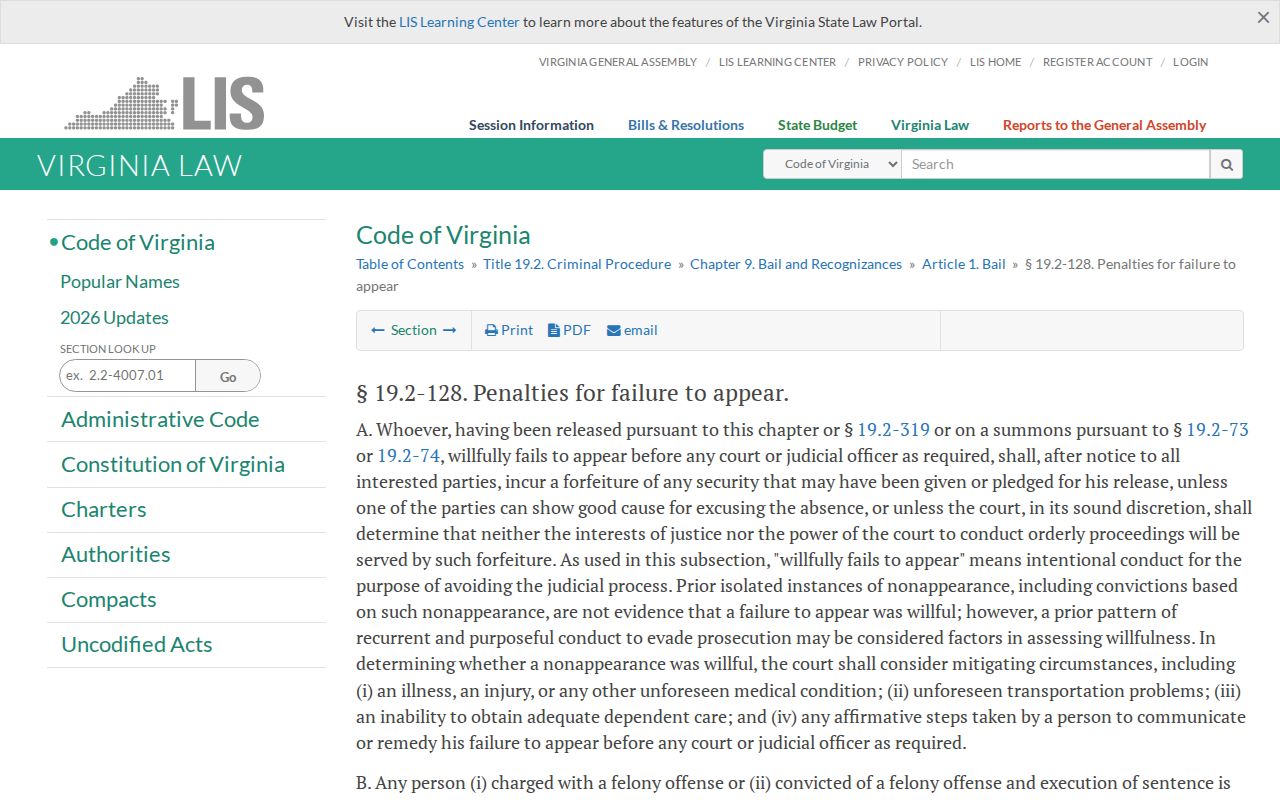
The statute is a general rule. Augusta’s issuing court still determines what a specific case requires.
Resolving an Augusta County Bench Warrant
Use the issuing court to confirm whether the process remains active and what remedy it accepts. No Augusta source publishes a universal walk-through form or promises that an online payment recalls a capias. A lawyer can help arrange an appearance, bond hearing, motion, or voluntary surrender when appropriate.
- Find the case in OCIS if it is covered, then note the exact court, locality, and case number.
- Call the clerk and ask the reason for process, appearance requirement, bond instruction, and whether a motion is needed.
- If the court directs an appearance or surrender, ask what to bring and where to report before travelling.
- After payment or court action, keep the receipt or order and ask when the Sheriff’s entry will update.
Caution: Do not assume the warrant disappeared after paying the underlying amount; ask the court to confirm recall and the Sheriff to confirm its agency record.
Augusta County Capias Service Counts
The County’s annual measures track service activity, not the current number of open cases. In 2024, the Sheriff reported 5,300 criminal warrants and 2,039 capias served. In 2025, the budget service table lists 5,541 criminal warrants and 2,286 capias served. A capias count reflects work done during the year, not one person’s status.
That distinction is useful when a court case search shows a capias label. The clerk can explain the case; the Sheriff can explain the service record.
Augusta County Bench Warrant Contacts
The issuing clerk depends on the underlying matter. Circuit handles felony indictment process, GDC handles adult traffic and misdemeanors, and JDR handles juvenile, family, and support cases. The Sheriff is the principal county serving agency, not the court that recalls a capias.
| Case type | Office | Contact |
|---|---|---|
| Felony or Circuit capias | Circuit Clerk | Criminal Division (540) 245-5016 |
| Adult traffic or misdemeanor | Augusta GDC | (540) 245-5300 |
| Family or juvenile matter | Augusta JDR | (540) 245-5306 |
Finding the Court That Issued the Warrant
Use the locality and court printed on the summons or order. If the case is not clear, the Virginia case system can point to a covered clerk, and the Sheriff can route a question about its service entry. Town ordinance cases from Craigsville or Grottoes use the applicable district court, not a separate town municipal court.
For an Augusta matter, ask the clerk whether the case belongs in Circuit, GDC, or JDR. The same court controls a reset or recall request. Keep the charge, setting date, and case number together when you call so staff can find the correct file.