
Searching for a Warrant in Augusta County
Virginia’s Online Case Information System is the public starting point for covered adult criminal, traffic, JDR, and select Circuit Court data. There is no Augusta County Sheriff public warrant-name portal. Search the right locality, then confirm any possible match with the clerk or Sheriff’s Records.
Have the name as printed on the summons, a case number, or a known hearing date. The Augusta Sheriff says Dispatch and Records maintain warrants and VCIN/NCIC entries, but those law-enforcement networks are not public lookup tools.
- Select the court and locality that match the paper. In GDC, search by full name, case number, or hearing date.
- For a felony indictment or Circuit matter, contact the Circuit Clerk’s criminal division because no single statewide Circuit search is available.
- For family, support, or juvenile matters, call Augusta JDR. Juvenile files are not part of an ordinary public search.
- Call the Sheriff at its published public number and ask for Records or Dispatch to explain the agency confirmation route.
- When the record is not public, send a focused FOIA request, then ask the issuing clerk about the required next step.
Virginia OCIS Covers Several Court Dockets
OCIS is a court-case index, not a live wanted-person system. The Virginia court case information page describes its coverage and directs users to court-specific links. Augusta General District Court is the first clerk contact for adult traffic or misdemeanor cases; a Circuit felony file may require its own clerk search.
Augusta’s magistrate service is another distinct office. It issues process and sets bail, but the published magistrate phone is not identified as a public status line. Use the clerk or Sheriff for confirmation of an existing case.
Warrant Search Fields Explained
The search help for Virginia General District Court recommends entering the name as it appears on the summons or warrant. A case number or hearing date can help when a name is common. Search fields identify a case, not a separate warrant record.
| Field Label | Type | Required | Notes |
|---|---|---|---|
| Court/locality | Select menu | Yes | Select Augusta or the locality named on the paper. |
| Last name | Text | Required for a name search | Use spelling printed on the summons. |
| First and middle name | Text | Optional or part of name search | Enter both when known to narrow common-name results. |
| Case number | Text | Alternative | Use the exact court case number; format varies. |
| Hearing date | Date/search option | Alternative | Use the known setting date; format is not specified. |
Augusta Search Uses Printed Name Order
The court’s search instructions say the strongest match comes from entering the name in last, first, and middle order as it appears on the summons or warrant. The help page does not describe wildcard behavior, an alias field, or a date-of-birth field. Do not assume a partial match or spelling variation will reveal the case.
If a search fails, check the citation or court paper for its exact case number and named locality. If there is no paper, ask the clerk which court should be searched before repeating the same name in multiple unrelated indexes.
What a Warrant Search Shows
A match can show the court case, charge, date, and status information available to that court system. It may not display the Sheriff’s current service status, the full warrant document, or a bond decision. Augusta’s published material does not identify a local warrant-number format.
| Process number | Format not published Ask the clerk whether the warrant has a separate identifier. |
|---|---|
| Case number | Connects the search hit to a court file, not necessarily a warrant number. |
| Charge or event | May show an offense, traffic matter, or failure-to-appear entry. |
| Court and locality | Identifies the clerk who can confirm the case and its remedy. |
| Bond and status | May be incomplete or not current in a public case view. |
A Negative Search Does Not Clear a Warrant
OCIS may not include every Circuit case, a fresh entry, a sealed matter, or juvenile information. Augusta’s Sheriff also has no public active-warrant list. Court and agency records may update at different times, so a blank search is not proof that no process exists.
The interface below is the official court search. Its controls help locate covered case information, but only the issuing court or the Sheriff’s Records route can confirm the status they maintain.
Open Virginia OCIS to review the court search interface used for Augusta cases.
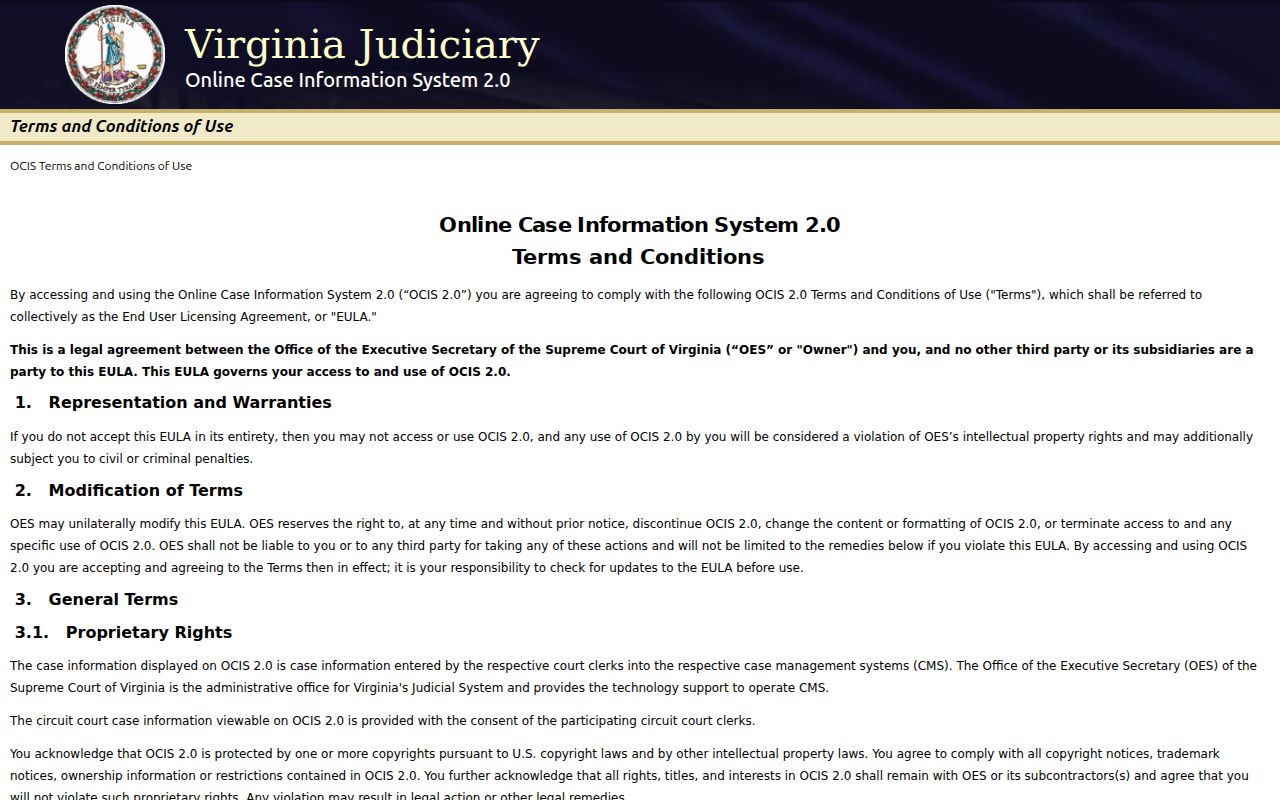
Keep the selected locality in view, then take the case number to the appropriate clerk for a current answer.
Where to Check Warrants in Augusta County
The clerk keeps the case file; the Sheriff maintains the law-enforcement warrant entry and serves process. For an Augusta Circuit felony, call the Circuit Clerk. For adult traffic or misdemeanor cases, contact Augusta GDC. JDR handles juvenile and family cases, with tighter limits on what can be shared.
Virginia has no single public statewide warrant search. VCIN and NCIC are restricted justice networks. OCIS is the public court-record fallback for covered cases, not a substitute for the Sheriff’s confirmation route or a clerk’s decision about recall.
Augusta Sheriff Records Need Direct Confirmation
The Sheriff’s divisions page says Dispatch and office staff maintain records, warrants, traffic summonses, and VCIN/NCIC entries. The public channel is the Sheriff’s Office at 127 Lee Highway; its general phone is (540) 245-5333. The research found no warrant-specific extension or web form.
Ask for the Records or Warrant Squad route and state that the question concerns your own status or a relative’s record. The public window has essential staff around the clock, but the official FAQ does not promise a walk-in recall or a bond service there.
JDR and Circuit Searches Need Separate Paths
JDR has a distinct clerk and juvenile confidentiality rules. A public GDC name search cannot establish whether a JDR file exists. Circuit criminal cases can also require a court-specific route. For adult traffic, Virginia’s GDC search and payment help lists name, case-number, and hearing-date options; an online payment control appears only when the case qualifies.
Do not assume a payment action changes a warrant. Ask the clerk whether another appearance is required and when the court and Sheriff records will reflect the result.
Restricted Warrants and Access Rules
Virginia FOIA allows requests for existing public records, but investigative, sealed, and juvenile material can be withheld. A Virginia search warrant affidavit and return are generally open after execution or 15 days, unless a court temporarily seals them. A limited record does not prove that no court process exists.
Key Rules:
Va. Code §19.2-54 provides access rules for executed search-warrant papers and allows a temporary seal.
Va. Code §16.1-301 keeps most juvenile law-enforcement records from public inspection.
Virginia FOIA exemptions can protect active investigative material; ask the clerk or Sheriff what can be released.